

Walk into almost any conference at four in the afternoon and look at the programme on the wall. Then look at the clock. The gap between them is rarely less than twenty minutes, and nobody in the room is surprised.
Running late is so normal at events that we have stopped treating it as a failure. But it is one, and a fairly expensive one: the closing keynote plays to a room that is already half on its way to the car park, the networking drinks shrink from an hour to thirty-five minutes, and the people who planned their train home around your published end time miss it, which is the last thing they will remember about your event.
The uncomfortable part is that events do not run late because of bad luck. They run late because the programme was built months earlier by people who were thinking about content, not time. Time at an event behaves in predictable ways, and once you know the patterns you can plan around them. Here are the ones that do the damage.
The programme was built on what people said they needed
Ask a speaker how long they need, and they will say twenty minutes. What they mean is that their talk, delivered at home to the bathroom mirror, lasts twenty minutes. On the day, it does not. They thank the host. They say something about the previous speaker. They notice the room is bigger than expected and slow down. A slide does not load. Someone asks a question in the middle. The twenty-minute talk is twenty-six minutes long, and that is a good speaker. A nervous one or an enthusiastic one is thirty.
The same is true of every number in your programme. A fifteen-minute coffee break is fifteen minutes from the moment the last person gets back to their seat, not from the moment the speaker stops talking. The walk out, the queue at the coffee, the toilet, the conversation that starts in the corridor and the walk back in take fifteen minutes on their own. Lunch for two hundred people is not sixty minutes; it is sixty minutes plus the time it takes two hundred people to pass through one buffet, and a single buffet line serves roughly three to four people a minute. Do the arithmetic before you print the programme.
Experienced producers deal with this by never using a speaker's own estimate. They take the stated length and add a quarter for talks and a third for anything involving a panel, a demo or audience interaction. If the programme does not fit once those numbers are in, it has too much in it, and it's better to find that out now than at 16:40.
Nobody owns the transitions
Look at a typical run of show, and you will see a column of start times and a column of items: 09:00 welcome, 09:10 keynote, 09:40 panel, 10:20 break. What you will not see is what actually eats the day: the gaps between them. The keynote speaker leaving the stage and the three panellists finding their way up, getting mic'd, sitting down, adjusting their chairs and being introduced is not zero minutes. It is four or five minutes, every time. Six transitions in a morning is half an hour that is not on the programme anywhere.
Transitions need to be planned as items in their own right, with a duration, and with a name next to them. Who walks the panellists to the side of the stage during the last three minutes of the keynote? Who has the lapel mics already on them? Who tells the host the panel is ready, so the host can bridge instead of fill? Where does the keynote speaker go, and who takes them there before they get stuck signing books at the foot of the stairs?
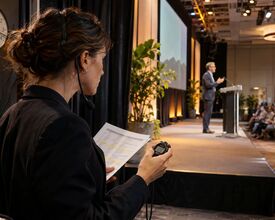
At larger productions, this is the job of a stage manager, and it is worth understanding what one does, because most corporate events have a host and think that is the same thing. It is not. The host is on stage and can only see what is in front of them. The stage manager is in the wings with a headset, a stopwatch and the run of show, and their only job is the next thing: is it ready, is the person here, does the technician know. A host manages the audience; a stage manager manages time. If your event is more than a few hours long and has more than four or five speakers, someone needs to be doing the second job, even if their business card says otherwise.
The Q&A has no way of ending
Here is a scene everyone knows. The session is scheduled to end at 11:30. At 11:28, the host says, "We have time for one or two questions". A hand goes up. The question is really a statement. The speaker answers at length because they are being polite. Another hand. The host, who is also being polite, takes it. It is now 11:39, and the next session has lost 9 minutes before it starts.
Q&A overruns because it has a start mechanism and no end mechanism. The fix is to build the end in before the first question is asked. Put a hard stop time on the Q&A, not on the session, and have the host say it out loud: "We have until 11:30, which is time for three questions, so please keep them short." Collect questions in advance or on a screen, so the host can choose, and the floor does not have to be opened at all if time is short. Tell speakers before the event that if their talk overruns, their Q&A is what gets cut, not the next person's slot. This has a remarkable effect on how long talks take.
And give the host a visible clock. Not a countdown on the confidence monitor that only the speaker can see, but something the host can glance at from the side of the stage. A great deal of overrun is simply people on stage who do not know what time it is.
The buffer is in the wrong place
Most organisers know they should build in a buffer. The usual way is to make every slot a bit longer: twenty-five minutes for a twenty-minute talk, and so on. This fails for a reason that is obvious once you say it: everyone uses the buffer. A speaker who has twenty-five minutes gives a twenty-five-minute talk. A break scheduled for twenty minutes takes twenty minutes, plus the usual five on top.
Buffer only works when it is invisible to the people who would use it. Keep the programme tight and put the slack in a few places that belong to you and nobody else: five or ten minutes before each break, a fifteen-minute cushion before the afternoon session, a closing slot that is shorter on the public programme than in your own run sheet. If the morning runs to time, those gaps become a slightly longer coffee, and nobody notices. If it does not, you absorb twenty-five minutes of damage without touching the programme.
Then publish the programme to attendees in a form that cannot slip. Give them session start times and break times, not end times for every item. A session that was going to end at 11:30 and ends at 11:36 is a non-event if nobody was promised 11:30.
When it has already gone wrong
Despite everything, at some point you will be twenty minutes behind. There are only three ways to get time back, and the choice among them should be made by one person in advance, not negotiated offstage.
The first is to shorten a break. It is the easiest and almost always the wrong choice, because breaks are where people do the thing they actually came for, and a ten-minute coffee break is a queue, not a break. Do it once if you must, never twice.
The second is to cut Q&A, which is why you told the speakers about it beforehand. Nobody in the audience notices a Q&A that did not happen.
The third is to cut or shorten a programme item. This is the one organisers avoid, and the one that works. It requires knowing in advance which item is cuttable, and telling the person involved before the event that it might happen. The sponsor's five-minute slot is not cuttable; it was paid for. The second panel on a topic the first panel already covered probably is. Decide now, write it down, and tell the host.
What you do not do is let the day drift and hope the lunch absorbs it. It never does. Time lost in the morning is still lost at five o'clock, and by then it has cost you the one part of the day that everyone was looking forward to.
The short version
Add a quarter to every speaker's own estimate and a third to anything interactive. Put the transitions in the run sheet as items, with a duration and an owner. Give someone the stage manager's job: watching the next thing, not the audience. Put a hard stop on the Q&A and say it out loud. Keep the slack where only you can spend it. Decide, before the event, which item gets cut if it comes to that. And give the host a clock.
If you are drawing up your run sheet with every transition timed and named, a shared one that each person on the crew can read on their phone, the call sheet tool on eventplanner.net is built for that. A printed spreadsheet does the job too. What matters is that the gaps are on it.
Events run late because time at an event is not what it looks like on paper. The organisers whose events finish when the programme says they will are not stricter or luckier. They just planned for the time the day actually takes, instead of the time everyone wished it would.
Source: Illustrative photo generated with the help of AI