


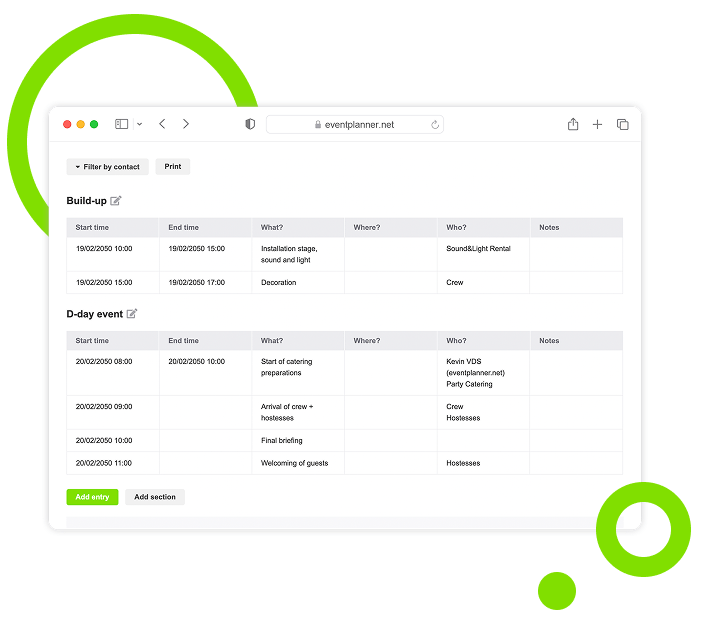
Manage Day-of-Event Activities with Call Sheets
Break event execution into minute-by-minute schedules for flawless coordination. Align your team with detailed plans for the event build-up and wrap-up.
Trusted by 179.000+ Event Organisers












Turn Team Tasks Into Clear Actions for Event Day
Stop stressing over miscommunication or missed cues during the event. Organise time blocks, assign staff roles, and deliver a well-coordinated show flow.
Keep Your Event on Schedule
- Prevent delays with precise task timing.
- Reduce stress with a well-organised timeline.
- Gain confidence knowing everyone is aligned.
Simplify Event Task Management
- Break complex workflows into manageable sections.
- Focus on what matters for each stage of your event.
- Navigate schedules with intuitive organisation.
Guide Your Team with Clear Direction
- Access personalised task list via app for fast action.
- Ensure offline readiness with printable schedules.
- Eliminate confusion with precise communication.
Gain Control Over Access and Visibility
- Share specific schedules with the right team members.
- Protect sensitive details with permission settings.
- Track accountability with role-specific assignments.
Discover Your Event Planning Toolkit
Learn how event call sheets integrate with other planning features within our event software.
Moodboards
Capture ideas, curate inspiration, and explore vendors to shape your event's vision, theme, and personality.
Checklists
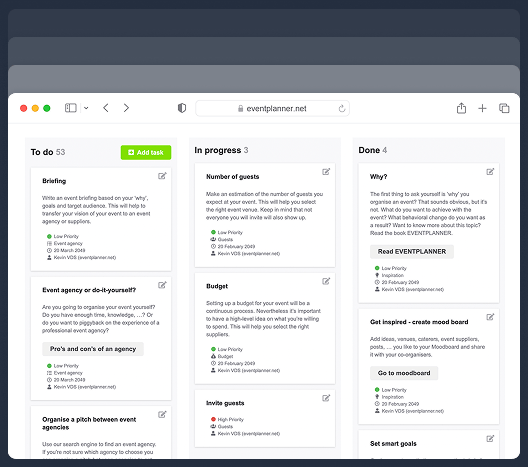
Keep track of every planning detail. Create and assign tasks to your team members, and never miss a deadline.
Budgets
Manage your event budget and expenses. Get a complete overview of fund allocation and track your spending.
Ticketing
Generate event tickets and manage on-site registration. Create easy check-in experiences for your attendees.
Suppliers
Manage every event partner from one workspace. Link them to budgets, call sheets, and the briefings they need.
Briefings
Build structured briefings that combine generic and supplier-specific instructions, all linked to the right partner.
Event Diagramming
Draw your event floor plan to scale, place tables, stages, bars and walls, and send the layout to your venue.
3D Event Design
Turn your floor plan into a 3D model, walk through it and view the venue before the event.
Plan / Seating
Design a floor plan, assign guests to seats, or let ticket buyers pick their own seat while ordering.
Event Timeline Setup
Configure detailed schedules and task assignments to organise your event-day flow.
Specify Task Timing
Define exact time windows and deadlines for each activity to maintain schedule control.
-
Add start dates and times for precise scheduling.
-
Set duration limits to prevent task overlap.
-
Configure deadlines to manage the event timeline.
-
Reconfigure task sequences for better flow.
Define Task Details
Include core task information and specifications for clear team communication.
-
Enter task descriptions to highlight requirements.
-
Specify locations for efficient venue navigation.
-
Assign team members for clear ownership.
-
Set status indicators for progress tracking.
Event Stage Coordination
Break down event schedules into manageable stages to simplify task execution and timing.
Structure Task Sections
Organise your team’s activity timeline into task-specific sections to cover every stage of the event.
-
Create and label sections to segment event stages.
-
Arrange sections in chronological order.
-
Filter tasks by team member to track progress.
-
Change or remove sections when plans change.
Manage Task Organisation
Arrange tasks within specific sections to maintain a structured event schedule.
-
Group tasks under the right sections for clarity.
-
Reorder tasks to match priorities and timeline.
-
View a summary of tasks in each section.
-
Mark tasks as complete to update progress.
Event-day Tasks Management
Download our app for real-time coordination or/and prepare offline-ready documents
Manage Onsite Tasks Via App
Access your tasks before, during, and after the event directly in the app.
-
Receive instant updates and adapt to changes.
-
Track task progress with live follow-ups.
-
Access personalised tasks for precise coordination
-
View tasks in sections for organised execution.
Generate Physical Documents
Create printable versions of event schedules for offline use and team reference.
-
Print schedules to share with everyone involved.
-
Generate task lists by role for quick distribution.
-
Include status details for meeting preparation.
-
Produce copies as backups for reliability.
Team Roles and Responsibilities
Set up role-based permissions and task visibility to enable team coordination and accountability.
Handle Task Assignment
Define task ownership and assign granular responsibilities across your event schedule.
-
Designate primary task owners for ultimate authority.
-
Add supporting team members to balance workloads.
-
Create vendor contacts for external task delegation.
-
Monitor task distribution to identify bottlenecks.
Oversee Access Rights
Configure viewing permissions and information sharing to maintain security of event data.
-
Set task visibility for targeted distribution.
-
Assign role-based access levels for standardised control
-
Track sensitive information flow for data protection
-
Monitor team permissions for access compliance
Event Call Sheets, a Tool for Coordination and Execution
Set the foundation for your event day(s) with schedules that work for your team and vendors. Turn your task list into minute-by-minute actions for timely execution.
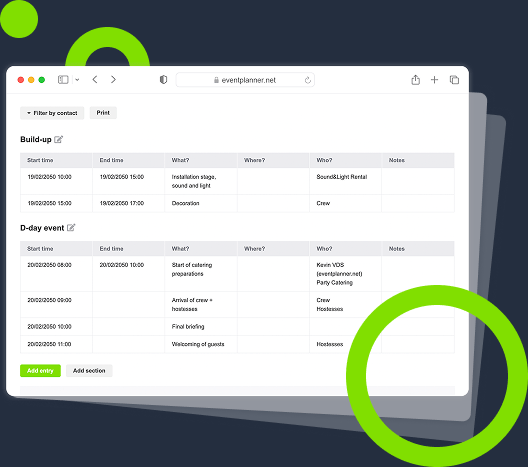
Visualise Actions, Direct Execution
Track your entire event timeline, team assignments, and progress updates from a single command center.
Unite Teams and Vendors, Maintain Alignment
Unite your staff and vendors under one system. Everyone knows their role throughout the event.
Coordinate Timelines, Drive Action
Direct your event with precision. Every task owner receives clear instructions exactly when needed.
Update Plans, Preserve Flow
Adjust your plans instantly as circumstances change. Keep your event flowing with real-time schedule updates.
Frequently Asked Questions
-
Can I use call sheets for multi-day events?
Absolutely. You can create separate sections for each event day or maintain a continuous timeline. The system helps you organise tasks across multiple days while keeping them connected within the same event schedule.
-
Is there a mobile version for on-the-go updates?
Yes. Team members can access their call sheets through mobile devices. This makes it easy to view assignments and update task status while moving around the venue. You can download our app from the Apple App Store or Google Play Store.
-
How do I share specific tasks with team members?
You control what each person sees. Give team members access to all tasks or just their own assignments. Filter and print task lists for specific people.
-
Can I add external vendors to my event call sheets?
Yes. You can add vendors as external contacts and assign them specific tasks. They'll receive access to only their relevant sections of the call sheet. This will help maintain security while providing them the information needed for their role in the event.
-
Can I use the event call sheet offline?
Yes. Print your complete call sheet or filtered versions showing specific sections or team member tasks. Always have a backup copy ready.
-
What happens if I need to make last-minute changes?
You can update the call sheet in real-time, and all team members will instantly see the changes on their devices. For those using printed versions, you can quickly generate and distribute updated copies.
-
How do I track task completion?
Mark tasks as done using the checkbox next to each item. Track completion across sections and team members to monitor progress.
-
Can I reuse call sheets from previous events?
Yes. You can save call sheets as templates for future use. This is particularly useful for recurring events or similar event types, allowing you to maintain consistency while saving setup time.
-
What is a callsheet in event planning?
An event callsheet is a minute-by-minute run-of-show document that tells everyone working the event - team, suppliers, venue staff, performers - exactly when they need to be where, doing what. It's separate from the planning checklist (which covers the event project management months leading up to the event) and from the budget. The callsheet exists for one purpose: making the day itself run on time. The term comes from film and TV, where a daily callsheet tells the cast and crew when to arrive on set; the event-planning version applies the same logic to weddings, conferences, festivals, and corporate events.
-
What's the difference between an event checklist and a callsheet?
A checklist tracks tasks across the planning phase - book the venue, confirm the catering, send the invitations, sign the contracts. A callsheet covers the day of the event itself, broken down to the minute: 14:30 sound check, 17:00 doors open, 17:15 welcome speech, and so on. Both are essential, and both connect to the same suppliers and team members. eventplanner.net builds them as separate but linked tools - a callsheet row can reference a supplier from your supplier list, and a task in the checklist can mark 'create the callsheet' as a deliverable in itself.
-
Run-of-show vs. callsheet - are they the same thing?
They're closely related. A run-of-show is the high-level minute-by-minute schedule of what happens on stage or in the programme - usually shared with the AV team, presenters, and producers. A callsheet is broader: it includes the run-of-show plus who is responsible for what, contact details, location notes, and crew assignments. In practice, many teams use the terms interchangeably, and our callsheet tool covers both meanings - you can produce a run-of-show view filtered to programme content, or a full callsheet with role assignments and contacts. You can absolutely build the full run-of-show directly inside an eventplanner.net Callsheet: every programme moment becomes a timed row, and the callsheet structure lets you add the responsible owner, stage location, technical cue and any notes the AV team or producers need - all in one place rather than maintained as a separate document.
-
How do I build a wedding-day timeline?
A wedding-day timeline is a callsheet by another name. The standard structure runs from 'getting ready' in the morning through ceremony, photos, reception, dinner, party, and end-of-night logistics. Typical anchor points: ceremony start time (work backwards from there), photo windows (45-60 minutes after the ceremony), dinner service (90 minutes), and the formal moments through the evening (speeches, first dance, cake cutting). Build it in 15-minute slots, share it with the wedding planner or master of ceremonies, the photographer, the caterer, the band or DJ, and the venue coordinator - each of them only needs to see the slots they're involved in. eventplanner.net's Callsheet tool handles this directly: build once, share filtered views per supplier. Couples and planners using eventplanner.net as wedding planning software get the callsheet alongside the budget, supplier list and moodboard in one connected workspace, so the wedding-day timeline stays in sync with everything else as the plan evolves.
-
Can I access the callsheet on event day from my phone?
Yes. The eventplanner.net app gives every team member live access to their assigned callsheet items on event day, with updates syncing in real time as plans change on site. The app does require an active connection, so for venues with unreliable connectivity we recommend keeping a printed backup - every callsheet is printable and can be filtered per role, so the lighting tech does not get a 40-page document with three pages of catering tasks. Most experienced production teams do both: the app for live updates, printed copies as a fallback for the moments connectivity drops.
-
How do I share the callsheet with people who don't have an eventplanner.net account?
Add them as external contacts on the event and they receive the callsheet (or just their relevant sections) via secure link or email. Suppliers with a profile in supplier management already have their callsheet rows linked to them and can see them inside their account; ad-hoc crew, freelancers, or volunteers can be invited per event with view-only access. Printable PDFs are also exportable per role - useful for handing physical copies to people on the day.
-
Can I reuse a callsheet from a previous event?
Yes. Callsheets save as templates, which is particularly useful for recurring events - annual conferences, monthly client dinners, weekly broadcasts - where the timeline structure repeats even when the dates and content change. Pull last year's callsheet, adjust the dates and the specifics, and you keep the institutional memory of what worked. For agencies running similar event formats for multiple clients, this is one of the most-used time-savers in the platform.
free forever
Perfect for professionals and smaller event planning teams managing one event at a time.
from per seat/month
Great for professionals and larger teams managing multiple events at a time.
from per month
Perfect for organisations requiring custom solutions, advanced security, and dedicated support
Event Planning Software That Grows With You
Select a plan that matches your ambitions, whether you're managing a single event or running multiple projects simultaneously.