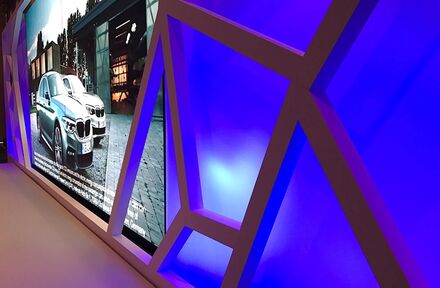



No one can deny that the technological revolution has transformed our industry for the better. High-resolution LED screens, the ability to change atmospheres with a single click, and the spectacular nature of digital content have allowed us to create experiences that were unimaginable fifteen years ago. AV suppliers have done an incredible job democratising a technology that is now the industry standard.
However, in this race for visual spectacularity, I sometimes wonder if we are falling into a dangerous inertia: the idea that "the bigger the screen, the better the event." The true design challenge lies in achieving perfect harmony between screens and physical scenography.
As a stage design professional, I would like to pose an open reflection to my industry colleagues, both technical and creative: Are we using technology to enhance the message, or are we inadvertently letting the background eclipse the subject?
When we place a speaker in front of a large-format LED wall with constantly moving graphics, we are asking the attendee's brain to make an extra effort to ignore the most powerful visual stimulus (the screen) and focus on the subtler one (the human). The result is cognitive overload. As various studies on screen exposure point out, this reduces the efficiency of the neural circuits involved in focused thought. Have you ever been at an event and noticed your gaze drifting to the background, losing the thread of what is being said? Perhaps the challenge is not adding more pixels, but intelligently managing screens and scenography so that the speaker remains the main focus.
Here I share four key points about the relationship between screens and physical stage design that I believe deserve a thoughtful conversation among us all.
1. Eye Biology and Audience Attention
We all know the power of good graphic content. But cognitive science reminds us of something basic: the human eye is hardwired to track light and movement.
When we place a speaker in front of a large-format LED wall with constantly moving graphics, we are asking the attendee's brain to make an extra effort to ignore the most powerful visual stimulus and focus on the subtler one. Have you ever been at an event and noticed your gaze drifting to the background, losing the thread of what is being said? Perhaps the challenge is not adding more pixels, but intelligently managing screens and scenography so that the speaker remains the main focus.
2. In a World of Screens, is Texture the Ultimate Luxury?
We live glued to digital devices. We spend our days staring at flat, light-emitting surfaces. Therefore, I wonder: when someone attends a live in-person event, what do they expect to find?
Perhaps what truly connects people today is seeing real volume, materiality, and depth again. A well-designed physical scenography offers a visual "rest" and a warmth that a screen, no matter how high its definition, cannot replicate. Could it be that the differential value of an in-person event today lies precisely in offering a tactile and three-dimensional experience, leaving digital elements as a complement rather than the whole? The quality of tangible scenography is our greatest asset.
3. The Coexistence of Light and Video
This is a point that directly affects the final image quality. Lighting designers know all too well how difficult it is to properly illuminate a person when there is a massive light source right behind them.
Often, the intensity of the LED "flattens" the subject or pollutes the scene, forcing the use of very aggressive front lighting to compensate. Physical scenography allows us to play with shadows, create volumes, and sculpt the space with light in a much more theatrical and emotional way. Can we find a middle ground where the video does not cancel out the magic of the lighting? The correct interaction between lighting, screens, and scenography is key.
4. Sustainability: What is truly more efficient?
This is where I believe we need to do the math honestly. We tend to think that digital is "clean" because it avoids physical construction. But if we look at the operational carbon footprint, the story changes.
A large-format LED screen running for days consumes a highly significant amount of energy (thousands of watts per hour), not to mention the necessary cooling. In contrast, scenography based on modular aluminium systems (highly reusable), FSC-certified wooden frames (reused 50% of the time), or recycled cotton textiles, has an energy consumption of zero during the event itself. If our goal is true sustainability, perhaps the most "eco-friendly" solution is not always the most technological one, but rather the one that consumes the fewest active resources on site.
Conclusion: Seeking harmony between Screens and Scenography
This is not at all about returning to the Stone Age or eliminating screens. They are fantastic and indispensable tools.
My proposal is simply that we regain balance. That technology becomes one more ingredient, not the only dish on the menu. I envision events where screens intelligently integrated with physical structures provide identity; where light, physical matter, and video dialogue to wrap around and support the message, rather than compete with it.
What are your thoughts? Do you believe we have reached the peak of stage digitalisation and it is time to reclaim the tangible, or is the future 100% digital?